Clubhouse
- 4.5
- Rating
- 10.00M
- Installs
- Free
- Price

 Analysis by App-foxy
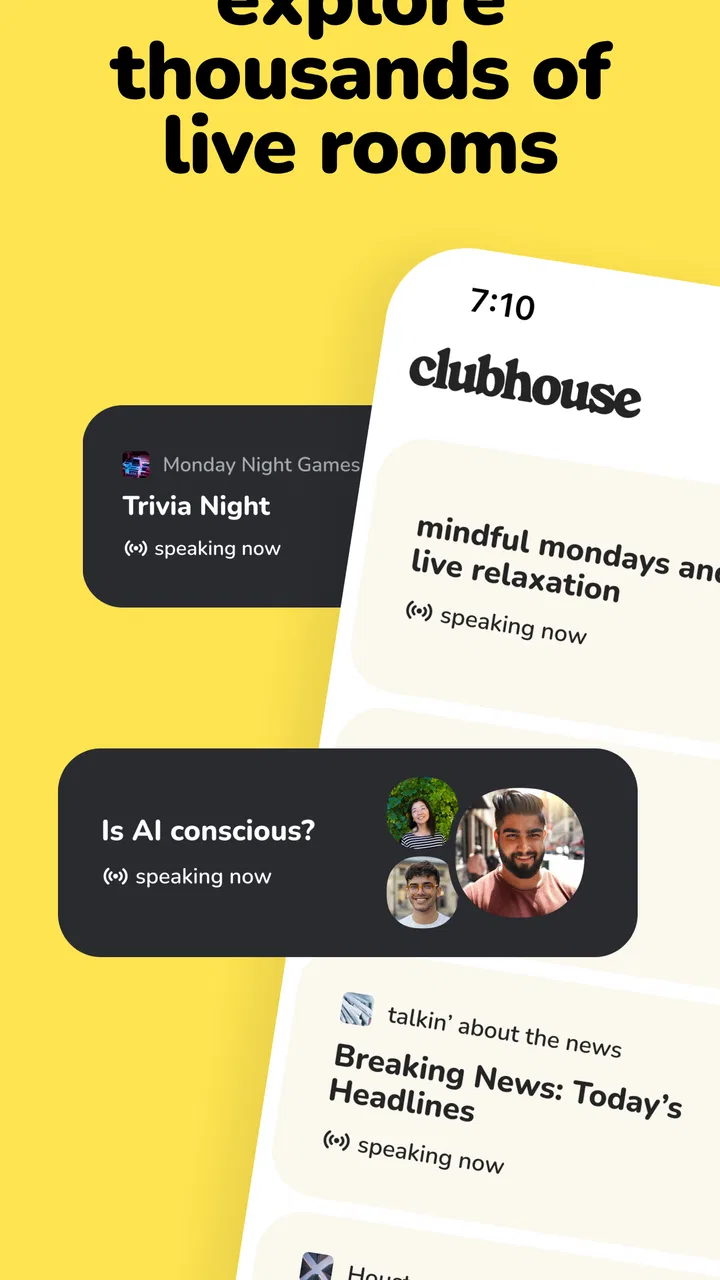
I approached Clubhouse as a place for live conversation rather than another feed to scroll. That distinction still matters. Instead of building the experience around written posts, photos, or edited videos, the app puts spoken interaction at the center, making it easier to drop into a discussion, listen for a while, and speak when you have something useful to add. In my experience, that makes it feel closer to an open group call than to a traditional social network.
It is a free social app from Alpha Exploration Co., rated for teens, and it has grown into a widely used service with more than ten million installs. Its average score sits at 4.5 from roughly 592 thousand ratings, which suggests that the basic idea continues to work for many people even though the experience is not perfect for everyone. The current version is 26.08.20, and it runs on Android 8.0 or later.
My overall impression is that Clubhouse is most valuable when I use it intentionally. I would not open it expecting a polished entertainment feed that constantly serves me exactly what I want. I would open it when I want to hear people think out loud, join a focused conversation, meet others around a shared interest, or make a distant community feel more immediate. That strength also creates its main weakness: the quality of the app depends heavily on who is speaking, how well a room is managed, and whether I am willing to participate in real time.
You May Also Like

 Pandora - Music & Podcasts
Pandora’s Music Is Easy to Start, but Harder to Recover
Pandora’s strength is its low-effort path from a seed to a station. Its weak spot is how much confidence it asks you to place in connection, setup, and quiet recovery.

 8 Ball Pool
 Is Built on Rivalries, Rematches, and Routine
A close look at the rivalries, rematches, shared routines, and unanswered safety questions that turn a quick pool match into a persistent mobile community.

 Samsung Music
’s Quiet Strength Is Playing What You Already Own
Its reach comes less from spectacle than from dependable access to a personal library. That simplicity is both the app’s strongest retention engine and its ceiling.

 AccuWeather: Weather Radar
AccuWeather Review: A Quick, Clear Forecast for Everyday Decisions
For everyday plans, the best forecast is the one you can understand quickly. AccuWeather makes rain timing, radar, and local conditions easy to act on, with a few trade-offs.

 Hill Climb Racing
Why Hill Climb Racing Still Turns Crashes Into One More Run
A tiny car, a bumpy hill and one more upgrade: Hill Climb Racing keeps resurfacing because its simple chaos makes every near-miss feel personal.

 AliExpress - Shopping App
AliExpress Makes Global Shopping Feel Personal, but Shoppers Bear the Risk
AliExpress turns a global marketplace into a pocket-sized discovery engine. Its reach is useful, its shopping loop compelling, and its trade-offs easy to miss.
More From Our News Desk
View All News


How Clubhouse feels today
The first thing I notice is the difference between listening and posting. On many social platforms, I need to prepare something before I can contribute. Clubhouse lowers that barrier. A room can be joined simply to listen, and the live format gives conversations a sense of movement that a comment thread often lacks. People interrupt, clarify, disagree, laugh, and change direction in ways that are difficult to reproduce with text alone.
That makes the app particularly useful for communities that benefit from discussion rather than announcements. I can imagine using it for a relaxed conversation about a hobby, a professional topic, a creative project, or a current interest where several viewpoints are more useful than one finished article. The best rooms feel informal without being completely unstructured. I can listen quietly, follow the thread, and decide later whether raising my hand is worthwhile.
The social design also changes how I spend time inside the app. A written feed encourages quick reactions and repeated checking. A live audio room asks for more attention. I may enter for a few minutes and stay because the discussion develops, or leave quickly when the topic is too broad or the speakers are not adding much. That unpredictability is part of the appeal, but it means Clubhouse rewards curiosity more than strict efficiency.
A realistic everyday use
Imagine that I am commuting home and want something more engaging than a podcast but less demanding than a video call. I can open Clubhouse, look for a live room related to a subject I already care about, and listen while keeping my hands free. If the conversation becomes useful, I can stay; if it turns repetitive, I can leave without having lost much time. Later, I might return to a room to ask a question or join a smaller discussion.
That scenario shows where the app fits best. It is not necessarily a replacement for a private call with friends, because a private call gives me more control and a clearer expectation of who will be present. It is also not a direct replacement for a podcast, because the conversation may be uneven and I cannot assume the same level of editing or structure. Clubhouse sits between those experiences: live, social, and spontaneous.
I also find the format useful for people who are tired of presenting a carefully edited version of themselves. Speaking live can feel more human than composing a perfect post. At the same time, that openness requires judgment. A room can become noisy, repetitive, or uncomfortable, and I need to be prepared to leave rather than expecting every conversation to be moderated to my taste.
What makes the audio format worthwhile
The strongest advantage is the speed of exchange. When someone asks a question, another person can respond immediately, and the original speaker can react to that answer. That back-and-forth often produces useful nuance. A short written reply may flatten a complicated idea, while a spoken explanation can reveal uncertainty, context, or a practical example.
There is also a sense of shared presence. Even when I am only listening, I know that other people are hearing the same conversation at the same time. That can make a niche interest feel less isolated. For someone who works alone, studies remotely, or wants to find people outside their immediate circle, this quality may be more important than the number of available topics.
However, I would not confuse live audio with guaranteed depth. A room can have many participants and still offer little substance. Popularity does not automatically make a discussion useful, and a confident speaker is not necessarily a reliable one. My practical advice is to treat rooms as conversations to evaluate, not as authoritative sources simply because they sound lively.
What has changed and what that means for users
Clubhouse was released on May 20, 2021, so it is no longer a brand-new experiment. The current version, 26.08.20, shows that the product has continued to evolve rather than remaining frozen around its original launch concept. I see that evolution less as a reason to expect a completely different app and more as evidence that the service is trying to make live social audio sustainable for everyday use.
For an existing user, the important point is that the app is now better understood as an ongoing social environment rather than a novelty to visit once. The value comes from finding the right conversations and people over time. That means a first session may not represent the full experience. If my initial rooms are uninteresting, I would adjust the people and topics I follow before deciding that the entire service has nothing to offer.
The version information is also practical for anyone using an older phone. Android 8.0 is the minimum operating system, so a device that cannot meet that requirement will not be a suitable home for the current app. For users on supported phones, keeping the app current is sensible because live communication services often depend on ongoing improvements to compatibility and stability, even when the visible interface does not change dramatically.
The developer is Alpha Exploration Co., and the app’s continued presence in the social category suggests that Clubhouse is being maintained as a real platform rather than treated as a short-lived audio trend. Still, I would separate that observation from any promise about future direction. A current version tells me what I can use now; it does not guarantee which conversations, tools, or community patterns will dominate later.
The effect on people who already use it
If I have used Clubhouse before, I would approach the current release with realistic expectations. The core attraction remains live voice, so I should not expect an update to remove the need to search, listen, and choose rooms carefully. The app can become more comfortable to use over time, but the social quality will still vary from room to room.
One useful workflow is to separate discovery from participation. I can first spend a short period listening to several rooms, notice which speakers explain ideas clearly, and then return to the conversations that consistently respect the topic. This is more effective than joining every room with an appealing title. It also reduces the chance of spending an entire evening in discussions that sound promising but never become focused.
Another practical habit is to treat speaking as a contribution rather than a performance. I get more from the app when I prepare one clear question or a brief example instead of trying to dominate the room. That approach helps me decide whether a conversation is genuinely welcoming and informative. If the room ignores thoughtful questions or rewards only the loudest voices, that is useful information about the community, not necessarily a problem I can solve by staying longer.
For people returning after a long break, the social graph may matter more than the interface. The best experience depends on whether the people and subjects I care about are active and easy to discover. I would give the app enough time to rebuild a relevant listening routine, but I would not force it if my interests are better served by a group chat, a forum, or a curated audio service.
Where it compares with familiar alternatives
Compared with a standard group chat, Clubhouse is more open and less dependent on everyone already knowing one another. That makes it better for discovery and casual participation, but worse when I need privacy, a permanent written record, or precise control over attendance. For family plans, sensitive work discussions, and detailed coordination, I would choose a private messaging or calling tool instead.
Compared with a video meeting service, Clubhouse feels lighter because the conversation does not require the same visual commitment. I can focus on voices and ideas without preparing a camera view. The trade-off is that visual cues are limited, and the room may feel less organized than a scheduled meeting with a clear agenda. If the purpose is collaboration on documents or demonstrations, a video or productivity tool is the more practical choice.
Compared with podcasts, Clubhouse offers immediacy and the possibility of interaction. I can ask a question rather than waiting for a future episode, and I may encounter perspectives that would never appear in a polished production. Podcasts remain better when I want reliable pacing, editing, consistent sound, and the ability to listen whenever I choose. Clubhouse is strongest when spontaneity matters more than polish.
Compared with text-based communities, the app can create warmth and momentum more quickly. Hearing a person explain an idea often makes disagreement feel less abstract. Yet text is easier to search, quote, revisit, and process at my own speed. I would choose a forum when I need a durable knowledge base, and Clubhouse when I want the energy of a live exchange.
Practical habits that improve the experience
I get better results when I enter with a purpose. Before opening a room, I ask whether I want to learn, meet people, relax, or contribute. That small decision helps me judge the conversation fairly. A room that is poor for learning may still be enjoyable for casual company, while a highly informative discussion may not be the right choice when I only have a few spare minutes.
I also recommend leaving early when the room has clearly drifted. The live format can create a feeling that leaving is rude, but it is not. My time is the main resource I am spending, and switching rooms is part of using the app well. I would rather sample several conversations than remain loyal to one that has stopped being useful.
A less obvious trade-off is the difference between visibility and comfort. Speaking can help me become recognizable within a community, but it also makes my contribution more exposed than a private message. I would begin by listening, then ask a focused question, and only take a larger role after I understand the room’s tone. That gradual approach is especially helpful for younger users, since the app carries a Teen content rating and live interaction can be less predictable than edited content.
Finally, I would avoid treating every room as a substitute for research. Live audio is excellent for discovering questions, hearing personal experiences, and learning how different people frame a subject. It is less dependable as the only basis for important decisions. I use the conversation to identify useful leads, then verify serious claims elsewhere.
Remaining gaps and who should skip it
The biggest limitation is inconsistency. Clubhouse can be fascinating one day and ordinary the next, because the experience is shaped by the live rooms available at the moment. If I need a predictable stream of high-quality material, I may become frustrated. The app asks me to participate in discovery instead of handing me a perfectly filtered sequence.
Live conversation can also be demanding in ways that are easy to overlook. I need enough attention to follow several voices, understand context, and decide when to speak. That is different from reading a short post between tasks. Someone looking for a quiet, low-effort social app may prefer text, while someone who dislikes spontaneous interaction may find the central format uncomfortable.
There is a financial detail worth noticing as well. The app is free to download and use, but it includes in-app purchases ranging from $0.49 to $499.99 per item. That wide range makes it important to review any purchase screen carefully rather than assuming that “free” means every optional element has no cost. I would use the service without spending first and decide later whether any paid option genuinely adds value for my habits.
I would also skip Clubhouse if my main goal is private, persistent communication. The app’s strength is the feeling of joining a live social space, not creating a carefully organized archive of messages. Likewise, people who want only professionally edited educational audio may be happier with podcasts or courses. Clubhouse can introduce me to ideas and people, but it cannot guarantee the structure or expertise those alternatives are designed to provide.
Another group that may want to pass is anyone who finds open-ended social discovery exhausting. The need to browse, sample, and judge rooms can feel like work. There is no shame in choosing a smaller community with a known group of participants. Clubhouse is not automatically better because it offers access to more voices; sometimes a limited, familiar setting produces a more useful conversation.
Questions I would consider before installing
If I am wondering whether I need an account to get value from the app, my answer is no in the beginning. Listening can be enough to decide whether the format suits me. I would not rush to speak or build a social presence until I had found rooms where the discussion quality matched my interests.
If I am concerned about using it on an older phone, the key check is the operating system. The current version requires Android 8.0 or later. That is the practical compatibility line I would verify before spending time setting up the app.
If I am unsure whether Clubhouse is safe for younger users, the Teen rating is a useful starting point, but I would still treat live rooms as less predictable than preselected media. A younger person may benefit from clear boundaries around which conversations to join, when to leave, and what personal information not to share. The live format deserves active judgment rather than passive trust.
If I am deciding between Clubhouse and a conventional social network, I would choose Clubhouse when I want voices, exchange, and unexpected encounters. I would choose the conventional network when I want visual updates, written records, or asynchronous replies. The choice is not about which platform is universally superior; it is about whether I want to participate in the moment.
If I am worried about paying accidentally, I would remember that the app is free but offers optional purchases from $0.49 up to $499.99 per item. I would review the purchase details before confirming anything and use the free experience as the real test. If the conversations do not hold my attention without extras, spending more is unlikely to fix the underlying mismatch.
What I would watch next
The most important thing to watch is whether Clubhouse continues to make discovery feel worthwhile. A live audio service succeeds when I can repeatedly find conversations that justify my attention. The current version shows ongoing product development, but the lasting test is whether the community remains active, varied, and welcoming enough for people to return.
I would also pay attention to how the app balances spontaneity with control. The loose format is what gives Clubhouse its personality, yet users still need practical ways to manage their time and choose better rooms. Improvements that make discovery clearer without turning the service into a rigid schedule would strengthen the experience.
For existing users, the best approach is to keep expectations grounded. The app is not a podcast library, a private messenger, or a formal meeting platform. It is a live social layer where the right room can feel unusually personal and the wrong room can feel like wasted time. That contrast will probably remain part of its identity.
My recommendation is therefore selective but positive. I would suggest Clubhouse to someone who enjoys hearing different perspectives, wants low-pressure access to live discussion, and is willing to explore rather than wait for perfect recommendations. I would not recommend it as the only social tool for someone who needs privacy, searchable records, or consistently edited content.
After using it with that mindset, I see the app’s value clearly: Clubhouse is at its best when live conversation is the point, not merely a feature added to a conventional feed. It can turn an empty commute, a quiet evening, or a niche interest into a shared moment. The experience is uneven, and the optional purchases deserve attention, but for the right listener, the immediacy of hearing real people respond in real time remains difficult for text and recorded media to copy.
FAQs for Clubhouse
01What is Clubhouse and how does it work?
Clubhouse is an audio-based social networking app where people join live virtual rooms to listen to or participate in conversations. Rooms are organized around topics such as technology, business, entertainment, education, and current events. Some users speak on stage, while others listen as audience members and may be invited to ask questions or share their opinions. Conversations can be casual, scheduled, or hosted by clubs and communities.
02Is Clubhouse free to download and use?
Yes, Clubhouse is generally free to download and use on compatible Android and iOS devices. You can create a profile, follow people and clubs, join available rooms, and participate in discussions without paying a subscription fee. However, your normal mobile data or Wi-Fi costs still apply. Certain creators or communities may also use optional features, events, or external services that could involve separate charges.
03Do I need an invitation to join Clubhouse?
Clubhouse originally became known for its invitation-only registration system, but access requirements have changed as the platform has developed. In many cases, new users can sign up directly with a phone number and create an account without receiving an invitation. Availability and registration options may vary by country, device, or current app policy, so it is best to check the sign-up screen after installing the latest version.
04Can I use Clubhouse without speaking or showing my camera?
Yes. Clubhouse is primarily designed around live audio, so you do not need to turn on a camera or appear on video. You can enter a room as a listener, keep your microphone muted, and leave whenever you want. If you wish to speak, you can usually raise your hand and wait for a moderator to invite you onto the virtual stage. This makes the app suitable for passive listening as well as discussion.
05Is Clubhouse safe and private to use?
Clubhouse includes tools such as blocking, reporting, room moderation, and privacy settings, but users should still be careful because conversations are live and may include unfamiliar participants. Avoid sharing passwords, financial details, private contact information, or sensitive personal stories. Room discussions may also be described or recorded by other participants outside the app, even when recording is not officially supported, so consider the audience before speaking.
Pros
- Live audio conversations feel spontaneous and more personal than text chats.
- Users can join discussions with experts
- creators
- and niche communities.
- The app makes it easy to discover rooms based on interests and followed clubs.
- Listeners can quietly enter rooms without needing to speak or turn on a camera.
- Scheduled rooms and notifications help users keep track of upcoming conversations.
Cons
- Conversation quality varies widely
- and some rooms offer little useful moderation.
- Popular rooms can become crowded
- making meaningful participation difficult.
- The audio-only format may be inconvenient when visual explanations are needed.
- Frequent notifications can feel excessive unless notification settings are adjusted.
- Useful discussions may be missed because rooms and conversations are often temporary.

Clubhouse
Gallery